
Dashboard Suction Mount 30-Day Test: Heat Fade, Re-Stick Reliability, and Windshield Vibration Drift
Keywords: dashboard suction mount 30 day test, windshield phone holder heat fade, suction cup restick reliability, car phone mount vibration drift, summer cabin suction mount test, suction phone holder long term review
Suction mounts look easy in product photos. Press cup, flip lock, done.
For a direct charging-vs-non-charging ownership comparison, see Wireless Charging vs Non-Charging Mounts (30-Day Test): Heat, Battery Health, and Daily Convenience in Real Commutes.
This article is a full 30-day field test focused on the practical things people actually notice while driving: does the cup stay sealed, does the angle drift, how often do you need to re-seat it, and what changes after hot-cabin parking. If you want the vent side first, start with Vent Hook Mount 30-Day Test: Slat Stress, Re-tightening Frequency, and Summer Stability and [Vent Phone Mount 30-Day Real-Life Test: Clip Fatigue, Heat Drift, and Rough-Road Stability]. For a tighter stop-and-go comparison against vent setups, read Magnetic Vent Mount vs Suction Mount in Summer City Traffic: 14-Day Stop-and-Go Stability and Heat Drift Test. Here, we are strictly in suction territory.
Test setup and routine
I ran a mixed routine across city traffic, patched suburban roads, and highway stretches with sustained vibration. The same phone and case combinations were used throughout to avoid fake stability gains from a lighter device profile. Mount points were kept consistent after initial placement so the comparison reflected long-run behavior, not endless repositioning.
Each day I logged: 1) first-try hold success 2) lock confidence after installation 3) micro-drift under vibration 4) one-hand dock/undock stability 5) post-heat cabin behavior 6) re-seat or re-stick frequency
I also tracked how each system behaved after windshield cleaning and after normal dust accumulation because suction mounts are unusually sensitive to surface condition.
Week 1: Predictably strong start
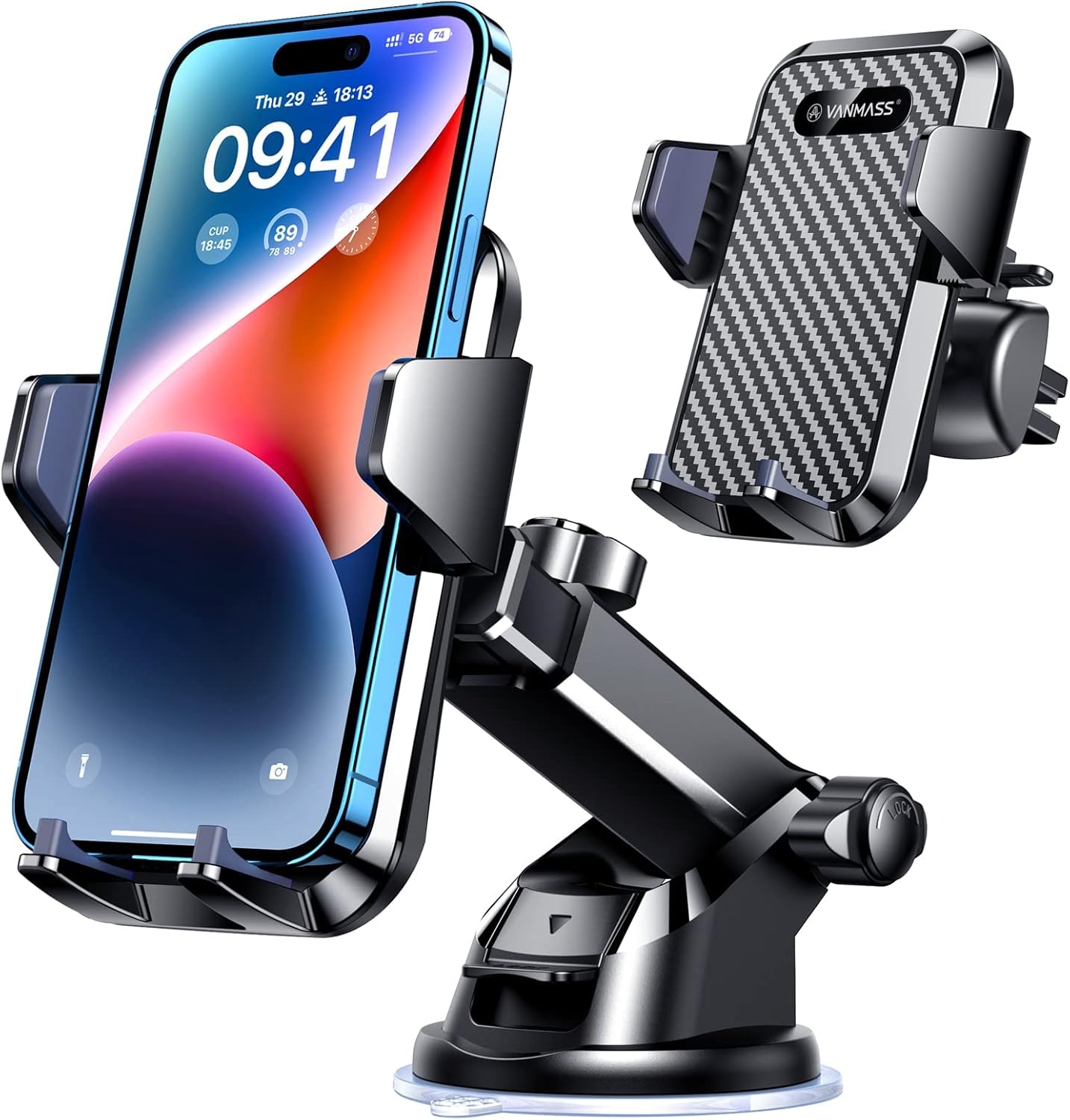
Good reference point for suction lock confidence and mixed-surface flexibility over long daily use.
Check Price on AmazonWeek one is where suction mounts earn their reputation. The better models feel planted, navigation glance angle is excellent, and operation is effortless. On clean glass, strong cups with a good lock mechanism can feel nearly fixed.
Still, subtle differences appear early. Some setups hold position but transmit more vibration through longer arms. Others damp vibration better because their pivot points and arm lengths are better balanced. This is one reason raw strong hold claims are not enough without geometry context.
For baseline references, I compared behavior against VANMASS 85+LBS Car Phone Mount Review: Strong Hold, Real-World Tradeoffs, iOttie Easy One Touch Signature CD Slot Mount: Reliable Mounting Without Suction or Adhesive, and [Windshield Phone Mount 30-Day Real-Life Test: Visibility, Stability, and Daily Pros/Cons]. Not every product in those pieces is suction-only, but they provide useful behavior anchors for lock feel and long-run confidence.

Popular suction benchmark for repeat dock/undock usability and stable viewing angle.
Check Price on AmazonWeek 2: Heat starts separating the field
By the second week, temperature swings started to reveal the real quality gap. Better cups recovered seal quality after heat-soak with little user intervention. Average cups were still usable but asked for occasional pressure reset or lock re-check after parked-in-sun sessions.
This is where buyers often misread the problem. If your mount drops once, it is easy to blame one bad install. If it repeatedly asks for tiny corrections after heat cycles, that is usually a system-level issue: cup material behavior, lock design tolerance, and mounting surface compatibility all at once.
Dust and skin oils also matter more than most people expect. A quick wipe helped many borderline setups regain confidence, but that maintenance rhythm itself became part of the ownership experience.

Useful multi-position comparison when testing restick reliability across dashboard and windshield.
Check Price on AmazonWeek 3: Re-stick reliability and drift patterns
Alternative setup for drivers who want suction flexibility with backup placement options.
Check Price on AmazonWeek three was about repeatability. Could the mount return to stable behavior after re-seating, or did it become progressively more fussy? Better systems behaved predictably after a simple clean-and-reset. Weaker systems developed a pattern: they still held, but angle drift under repeated bumps increased, and confidence dropped because you kept watching the phone instead of forgetting it.
This attention tax is the hidden cost of mediocre suction setups. They do not fail dramatically every day. They interrupt routine in small, repeated ways.
One useful cross-check during this period was CD Slot vs Vent Mount 30-Day Test: Stability, Reach, and Daily Usability in Older Cars. It highlights that mount category choice should follow cabin realities, not only feature lists. In some older cabins, a lower-vibration anchor can outperform suction over time simply because surface angle and glass curvature are less forgiving.
Week 4: Long-run verdict after daily life
At the 30-day mark, the best suction setups shared three consistent traits: - stable lock mechanism that tolerated heat cycles - cup material that maintained seal behavior after cleaning and reuse - arm and joint geometry that limited vibration amplification
The weaker outcomes also followed a clear pattern: - rising re-seat frequency as days passed - small but recurring viewing-angle drift - increased sensitivity to minor surface contamination
Importantly, almost every setup could be made to work with careful maintenance. The difference was how much maintenance you had to think about. The best mounts disappeared into your routine. The weaker ones asked for attention every few commutes.
Buying advice from the 30-day data
Choose suction when: - you have a clean, compatible windshield/dash zone - you want flexible placement and high glance comfort - you are willing to do basic surface upkeep
Choose alternatives when: - your preferred glass area is highly curved or awkwardly angled - heat exposure is extreme and daily - you want near-zero maintenance behavior over long periods
For safer setup habits, pair this with How to Install a Phone Holder Without Damaging Your Car Dash and Heat and Shock Tests: Car Phone Mount Safety Explained. Installation quality and surface prep are still part of the performance equation, even with premium hardware.
Final takeaway
Suction mounts can be excellent daily tools, but their long-run quality is less about launch-day grip and more about consistency after heat, vibration, and repeated handling. Over 30 days, the winners were not the mounts that looked strongest in a single pull test. They were the ones that stayed predictable with minimal fuss.
If your current mount keeps asking for just one more adjustment, trust that signal. In real driving, repeatable stability matters more than headline claims.
For a cycle-based restart view after parked heat soak, read Phone Mount Summer Heat Recovery Test: 20 Parked-Car Cycles and Re-dock Stability in Real Commutes.
For the prep-method angle behind hold consistency, see Mounting Surface Prep Test: 12 Cleaning Methods Compared for Suction Hold, Adhesive Grip, and 14-Day Stability.
For a direct adhesive-versus-suction summer durability comparison, read [Adhesive Dashboard Mount vs Suction Mount in Summer: 30-Day Peel, Slip, and Reposition Test].
For a textured-interior durability deep dive, see [Textured Dashboard Survival Test: 8 Mount Base Materials Compared for Creep, Noise, and Heat Cycling].
For a windshield-focused long-run perspective, compare with Windshield Phone Mount 30-Day Real-World Test: Visibility, Stability, and Daily Pros/Cons.
If you are evaluating non-dash alternatives, Cup Holder Phone Mount 30-Day Real-World Test: Stability, Reach, and Vibration is a practical companion.
For quick selection before deeper testing, use MagSafe vs Clamp vs Suction: Which Car Phone Holder Should You Buy in 2026? and Best Car Phone Holders by Driver Type: Commuter, Rideshare, Truck, Family, and Delivery Use Cases (2026).
For humidity cycles and glass-adjacent installs during wet seasons, compare with Rain and Fog Readability Test: Wet Glass, Mount Height, and Safer Glance Time in Low-Contrast Weather.
Pair long-run suction drift data with short, violent wash cycles in Touch Car Wash Survival Test: When Your Phone Mount Is in the Brush Zone (Suction, Vent Hook, and Adhesive).
Screen-heavy EV dash and windshield placement diary (Model 3 / Model Y class): Model 3 and Model Y Phone Mount Field Test: 21 Days on Soft Dash, Long Glass, and Heat-Soak Re-seat Reality.
Winter wet-cabin suction and adhesive re-seat diary: Winter Wet-Cabin Week: Snow Melt, Humidity, and Suction Re-seat Honesty After Real Slush Days.
Review articles
View all →

